

But Catherine did not know her own advantages – did not know that a good-looking girl, with an affectionate heart and a very ignorant mind, cannot fail of attracting a clever young man, unless circumstances are particularly untoward.
From Northanger Abbey
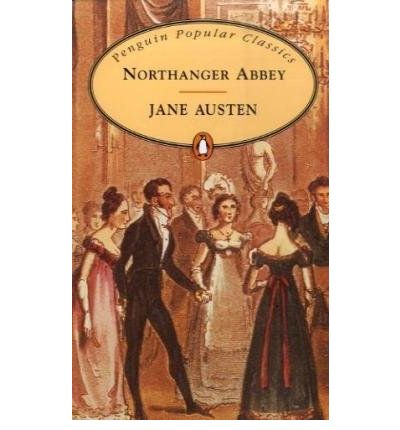
SYNOPSIS
Catherine Morland is an unremarkable young lady: ‘almost pretty’, an ‘inattentive and occasionally stupid’ tomboy with no propensity for arts or studies, from a generally happy family neither wealthy nor poor. Her one distinguishing trait? A deep love for Gothic novels. A foray into Bath society courtesy of a family friend becomes a real adventure for Catherine’s active imagination when charming Henry Tilney and his sister invite her to stay with them at their imposing family estate, Northanger Abbey. What mysteries is our unlikely heroine set to uncover within the ancient walls of the abbey?
REVIEW
I find Northanger Abbey the most underrated of Austen’s novels and maybe the most likely to be reevaluated through a modern lens. Mainly because of Catherine, who must be protected at all costs. At 17, she is on the younger end of Austen heroines, the same age as Lydia and Marianne, and by far the most likeable of the three. She displays all the endearing over-the-topness of a teenager without Lydia’s vanity or Marianne’s cutting judgment. More than anything, she is GENUINE. Catherine does something no other Jane Austen heroine does: she takes people at face value, and sees everyone in the best light until proven wrong. Her frequent confusion and frustration at people not saying what they mean highlights the artifice and stuffiness of Regency society. As an Austistic woman myself, I see in Catherine a mirror of the nightmare I’d have experienced in a society where everything is ambiguous and codified and artificial (or rather, even more so than it is today).
The social awkwardness is counterbalanced by hope: despite her naïveté making her prey to misunderstandings or selfish characters, Catherine is surrounded by people who appreciate and love her. Her family first and foremost, then Henry and Eleanor. Her family appears much happier and close-knit than, say, the Bennets. I think the light hearted acceptance of Catherine can be truly healing for people who grew up oddballs like myself.
A lot of the credit for Catherine’s upbringing goes to her mother, a woman equally as unaffected and well-meaning. Without the stifling eagerness of a Mrs Bennet or the lack of maturity of a Mrs Dashwood, Mrs Morland parents with an enviable balance of care and freedom. When she says that Catherine will make a poor housewife but it’s okay, she can always learn, she sounds like a mother who knows her children and their flaws well, and loves them as they are. Her innate practicality might make her unaware of her daughter’s sentimental drama, but with a gaggle of younger children, who can really blame poor Mrs Morland for not keeping up with what nobody’s telling her?
Then there is Henry. Henry’s an interesting hero, generally courteous and kind, often teasing and sarcastic, and not immune to flattery. He is 26 to Catherine’s 17, so they have a bit of an age gap, though more in Darcy-Lizzie territory than Emma-Mr Knightley. Austen often jokes in Northanger Abbey that men like to be flattered and to teach, and the more good-natured and teachable a woman, the more likeable she will be. This dynamic can be seen at play in many moments between Catherine and Henry and occasionally toes the line between fun and annoying. Catherine is no Lizzie Bennet, so the reader is at times in the peculiar position where we understand Henry’s teasing more than she does. On the other hand, Henry is no Mr Knightley, so their interactions are devoid of preachiness. Henry overall comes across as a kind dude who likes fun, light-hearted banter and is truly endeared to this jolly, imaginative girl, who just so happens to also flatter what little intellectual vanity he possesses. Also, he loves novels, helps his sister choose her gowns and, for Pete’s sake, who doesn’t want a guy who UNDERSTANDS MUSLIN?
Another lovely side of Northanger Abbey is the portrayal of friendships among girls based not on discussing men, but books and family matters. Catherine first becomes friends with Isabella through gushing over Gothic novels. Later on, many of her conversations with Eleanor revolve around the Tilney family and the siblings’ mother. Family dynamics and friendships are a cardinal theme of Northanger Abbey.
Tiny note without going into detail, because I fear I’ve already said too much: the VILLAINS. Northanger Abbey has a few great red herring antagonists, and the final villain is one of the most prodigious Austen ones, in my opinion even rivalling Lady Catherine De Bourgh for sheer selfishness, mean spirits, and imposing nature.
Lastly, the author’s voice is wonderfully meta in this book. Because it was meant as a satire of the fashionable Gothic novels of the time, Austen launches in a couple of delicious tirades on the subject. Her voice is often very prominent in the books, but here it’s more meta than ever, often tossing in little asides like: ‘And now I may dismiss my heroine to the sleepless couch, which is the true heroine’s portion – to a pillow strewed with thorns and wet with tears.’ At times, it almost feels like Austen is perched on the reader’s shoulder telling the story and poking fun at both her characters and us. Like she’s saying: ‘You know this is just a novel, right?’
CONCLUSION
A wonderful Austen book, with far more endearing characters than some of her greatest and more famous, an unusual and delightful meta voice, an appropriately Austenesque plot. And I reiterate: a love interest who understands muslin.
BONUS QUOTES
But the inexplicability of the General’s conduct dwelt much on her thoughts. That he was very particular in his eating, she had, by her own unassisted observation, already discovered; but why he should say one thing so positively, and mean another all the while, was most unaccountable! How were people, at that rate, to be understood?
Catherine Morland, summing up the Autistic experience in society at large.
The person, be it gentleman or lady, who has not pleasure in a good novel, must be intolerably stupid.
Henry Tilney, ladies and gentlemen.
No one who had ever seen Catherine Morland in her infancy would have supposed her born to be an heroine.
Nobody can convince me that this isn’t the best start of a Jane Austen novel. Pride and Prejudice who?
It is only a novel… or, in short, only some work in which the greatest
powers of the mind are displayed, in which the most thorough knowledge
of human nature, the happiest delineation of its varieties, the
liveliest effusions of wit and humour, are conveyed to the world in the
best-chosen language.
Jane Austen telling it like it is


 Magnolia Fay Writes
Leave a reply to Calmgrove Cancel reply